Enhancement through knowledge

Wednesday, October 14, 2015

Harvesting Panda Red Arowanas


Despite being caught in a bad traffic jam on my way to Panda Aquatic Centre, it was all but a fine day for a visit to the countryside. The skies were clear and the air was fresh after a brief spell of rain the wee morning hours. Today, I would be witnessing the harvesting of the red arowanas from Panda Aquatic Centre.


Workers getting ready for the harvest.

I met up with Mr. Kan from Panda Aquatic Centre and was briefed by him on the schedule for the day. Both his red arowanas and his crossback arowanas will be harvested today.


Mr.Kan, CEO of Panda doing his harvest ritual. Just kidding, 
he is actually looking out for snakes for the safety of his workers.

As we walked towards the breeding ponds, his workers were already in the thick of the action. They were walking cautiously in the waist deep waters, planting the necessary nettings and bamboo poles in place to round up the red arowanas.


Workers wading slowly through the chest deep waters to guide the arowanas into the 
specially designed net. Mr. Kan beating the edge of the banks to urge the arowanas along.

Although Mr Kan did not enter the breeding pond, he was also doing his part along the edge of breeding pond with a wooden pole, striking the grass to ward off any snakes that might hurt his workers. As the workers slowly pulled the net along the pond to round up the arowanas, Mr. Kan then used his wooden pole to beat gently around the edge of the pond to urge the arowanas into the net.


The workers carefully ensuring that none of the arowanas were able to escape. 
Every arowana in the pond must be checked for eggs or fries.

While I have witnessed numerous harvesting of arowanas, each harvesting is quite unique. The harvesting procedures are quite similar but you never know what to expect in each harvesting. Beneath the murky waters of the breeding pond are actually numerous productive red arowanas, each capable of producing at least 20 fries! This is already quite a feat as red arowanas are often reported to have a lower productivity. The secret to having such a productive pool of breeding arowanas is probably known to the farmer but from what I have observed in Panda Aquatic Centre, Mr. Kan had probably done his research and set up his breeding ponds to simulate the natural environment of the red arowanas, ensuring that the right atmosphere and environment are present to boost his arowanas’ productivity! Not only were his arowanas productive, I was equally impressed with the physical appearance of his arowanas. Each red arowana displayed a beautiful coat of red scales. I would probably have to bring my water parameters test kits the next time I visit the breeding ponds to find out what is the secret to having such productive and beautiful red arowanas!


Hauling the net partially out of the pond.

When the red arowanas are hauled up from the water and inspected for fries, I could sense the great expectation and anticipation in everyone. There was tense concentration as the worker pried open the arowana’s powerful jaws to introduce the numerous fries to this new world!


Special bamboo sticks were strategiclly placed to form a barricade to prevent the arrowanas from 
leaping over the net. So far, this is only the easy part. Now, let's get to the business at hand!


Catching and inspecting all the arowanas in the pond. Not an easy task if you have slippery and strong jumping customers.

The same procedures of laying the nets and cornering the arowanas were repeated in the next pond. This time, the golden crossback arowanas will be harvested.


A male red arowana is slowly coaxed into the net.

The well-trained and experienced workers soon identified the male brooders. With a firm grip, the male brooder’s jaws were unlocked easily and this time, close to twenty crossback fries were released! It was quite a bountiful harvest, wasn’t it?


Gently prying open the mouth to remove the fries. An electronic scanner is also used to 
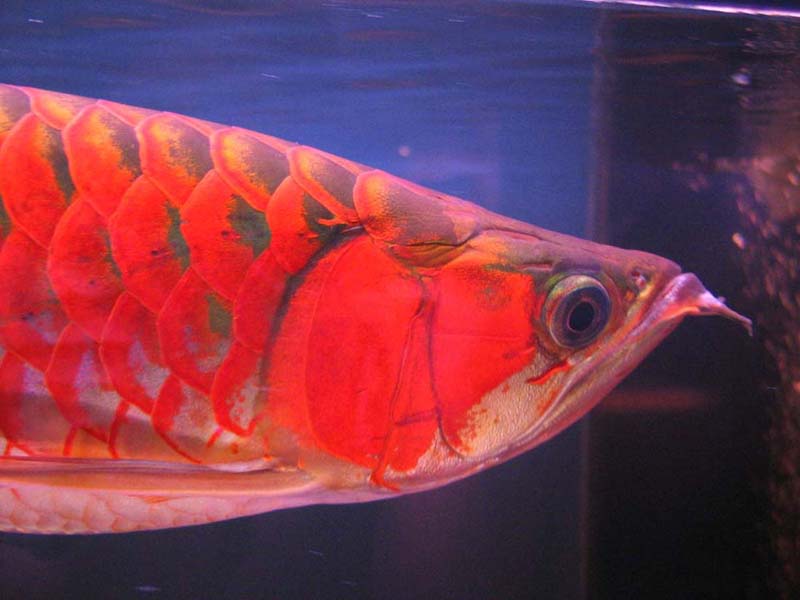
scan the tag number of the parent fish. A really fine specimen of red arowana. 1st of the day.


Reading out the tag number to AVA officials witnessing the harvest. Beautiful red arowana indeed.

Over twenty fries measuring about 1 inch each came from the first Red Arowana.


Another male brooder spotted! This piece is a real red shocker!

This time, there were over 40 fries taken from the brooder!

As well, some were already swimming about freely.

Three inch fry

A real catch of the day. Quality all over.

3 inchers up close.


Photos by West 
Article by NSK
Originally published in www.arowanaclub.com

Friday, October 9, 2015

Inspiration

I wish to share these 2 pictures of a beautiful red arowana, hopefully you will be inspired to keep arowanas.

Sunday, December 28, 2014

How old ? (Part 2)

I had earlier written an article titled "How Old? " on how old an arowana can get when kept in captivity at this post.

Recently, someone from our facebook page posted his pearl arowana aka Jardini, which he had kept since 1998! That's a long 16 years!


Monday, December 8, 2014

Treasures of Kalimantan

For a long time ago, the arowana or siluk was not hunted by the villagers that lived in numerous villages that dotted the numerous rivers and lakes in Kalimantan, Indonesia.

This changed when people believed that arowanas would bring good luck to their owners and soon this fish became 1 of the most expensive aquarium fish as demand outstripped supply. In their natural habitat, arowana population plummeted because of poaching for the aquarium trade and is now being classified under the red list of the Convention on International Trade in Endangered Species of Wild Fauna and Flora (CITES).


When the aquarium trade on arowanas first started, it was thought that arowanas were harvested from Kalimantan will always turn red or orange when the arowanas mature. However we now know that this is not true although the young arowanas had red fins and look very alike. The arowanas from Western Kalimantan along the Kapuas River region will turn orange or red when mature while those from Southern Kalimantan along the Bajarmasin region will remain silvery with yellow tails.


Naturally, differences in the colour of the arowanas also meant a difference in their prices. However, it would be difficult to identify a young red arowana from a young yellow tail as their young had similar features and red fins. The redness in the yellow tail arowana's fins would disappear only as the arowana matures. To differentiate between the 2, red arowanas from Kapuas region were called grade 1 red while those from Banjarmasin were called grade 2 red or Banjar red or 1.5 red.


Friday, May 3, 2013

Land before time ...

More than a million years ago, the islands of Sumatran, Java and Borneo and other smaller Indonesian islands were connected to Peninsular Malaysia on mainland Asia, forming the Sundaland. Geographical research has shown that Sundaland would include the southern tip of Thailand, the whole of Peninsular Malaysia, Borneo, Sumatra and Java.


Sea levels were significantly lower but suddenly rose during the Pleistocene. The connections to the mainland were covered by waters, leading to the formation and isolation of the islands.

Therefore, would it have been possible that the major rivers in modern Peninsular Malaysia, Sumatra, Borneo, Thailand and Cambodia were connected to form a major river system in Sundaland that hosted arowanas in its numerous rivers and lakes? As sea level rose, these rivers and lakes were disconnected when the land bridges disappeared. Could it be that the arowanas in each isolated river and lake further evolved to become the different arowana varieties that we know today? (hint: green arowanas are known to be found in Thailand, Cambodia and Tasek Bera Lake, Endau River and Trengganu drainage area).


Saturday, April 13, 2013

Disposing your arowanas

A silver arowana in a man made pond.


Many people bought young arowanas when they were merely 6 or 7 inches long to raise as pets as they believed arowanas to be auspicious and beneficial for their feng shui. These infant arowanas eventually grew up, up to 3ft long and often  require bigger tanks as the continued to grow. In land scarce Singapore where majority of the population lived in HDB flats, having big 5ft tanks to house a 3ft arowana can be quite a challenge. It could get to a point where desperate owners tried to sell or even release them in manmade ponds or reservoirs. In many cases, these fully grown but abandoned arowanas thrived and continued to breed. 

I personally do not think these arowanas should not be released in the wild or in reservoirs as these are not native to Singapore. They could be donated to the Singapore Zoo especially so when the River Safari (a river themed wildlife park) has recently opened. This would be a more humane way of disposing your pets rather than to dump them into the wild and upset the ecological balance.


A pair of yellow tail arowanas in the Singapore Zoo
Of course, you can also choose to sell them off in your friendly LFS or over Ebay :P

Monday, November 5, 2012

Preserving arowana bloodlines


An interesting article illustrating the charm arowanas have on humans. I'm not really a fan of platinum arowanas, just the good old red and gold arowanas.
http://thestar.com.my/news/story.asp?file=/2012/11/5/nation/12271102&sec=nation

Preserving arowana bloodline

Big catch: Chua looking at the hybrid platinum arowana. Because of its rare colour, it is worth the price of a new Toyota Camry.

MALACCA: He is a lawyer by training but Lincoln Chua's painstaking efforts to learn about arowanas has turned him into a fish biologist of sorts.

For almost three decades, he has been learning and researching about the ornamental fish. As for the 120 arowanas in his collection, Chua has been keeping a journal on their size, hue, behaviour and origin.
Chua, 45, is meticulous about their places of origin to ensure their lineage is protected.
“The pure Golden Crossback Arowana, which is unique to Malaysia, originated from Sungai Kerian and the Bukit Merah dam in Perak before it spread to nearby aquatic sites.”
He said their birthplace would distinguish them from others in terms of appearance, size and colour.
“In order to preserve a pure bloodline, it is advisable to mate the fish only with those from the same species,” he said at his home in Ayer Keroh.
Chua has converted the patio of his bungalow into a lush garden filled with customised fibreglass tanks. Among others, he has species from places like Bagan Samak, Selama, Changkat Lobak and Alor Pongsu rivers in Perak.
There is also a hatching room in his house to nurture fish fry.
Of the hybrids he owned, Chua noted that a platinum arowana he bought two years ago when it was only three-inches long was now worth the price of a Toyota Camry.
“It is exceptional because of its rare colour,” he said.
Chua said he was looking forward to the completion of his fish farm in Bukit Merah, Taiping, by the end of the year, adding that all his fish would then be transported there.